

A brilliant copyist and papal insider, a relentless hunter of lost books, a sharp-tongued satirist, and, rather remarkably, the man whose handwriting helped shape the very letters you’re reading now. Gian Francesco Poggio Bracciolini (1380–1459) was one of the most influential figures of the early Italian Renaissance, perhaps best known for his role in rescuing ancient classical works from near-oblivion and injecting them into the intellectual lifeblood of Europe.
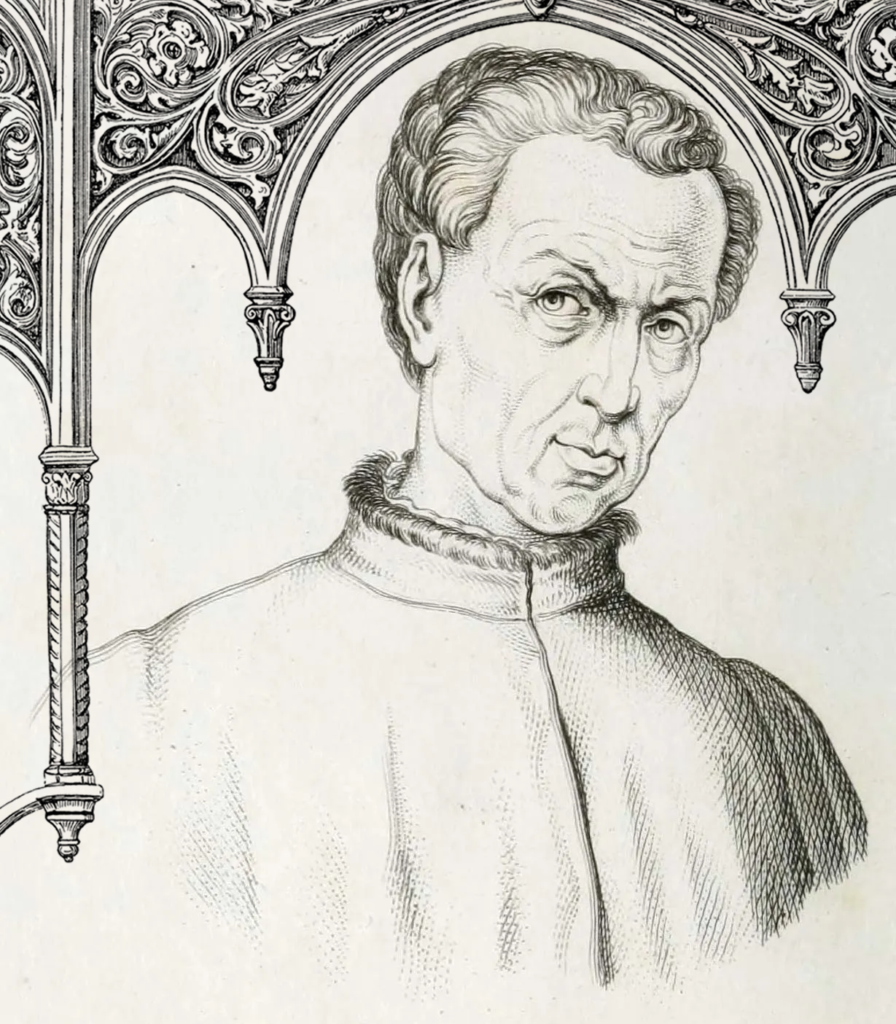
Born in the Florentine village of Terranuova, Poggio was deeply inspired by the revival of interest in ancient Latin and Greek culture that marked the Italian Renaissance. He studied Latin in Florence under a friend of the poet Petrarch and quickly gained a reputation as a bright, erudite scholar with a clear, legible hand. While working there as a professional scribe, he developed a distinct, rounded script inspired by earlier Caroline manuscripts of the 8th century. This “humanist script,” was elegant and highly readable, with each letter formed distinctly, a departure from previous styles. Polished further by later scribes, it quickly gained in popularity, becoming the model for the Roman typefaces used in early printing, and by extension, for modern typography.
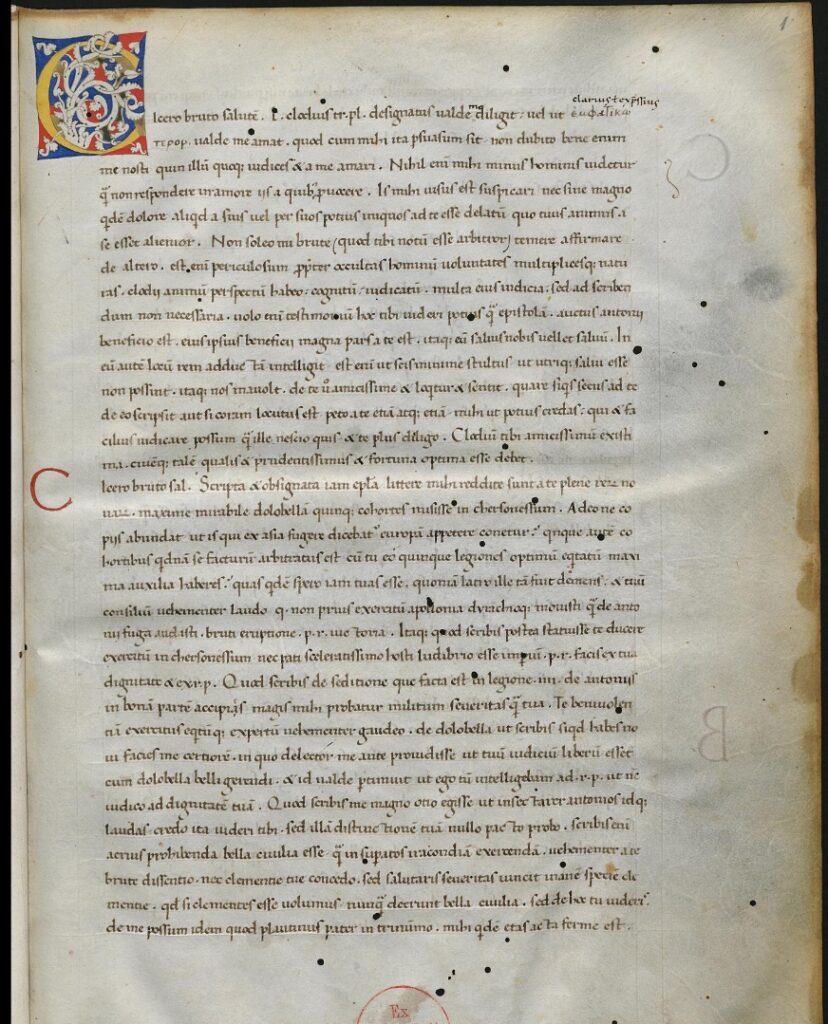
Staatsbibliothek, Berlin, Ms. Ham. 166, f.1r, 1408
His skill as a scribe brought him to Rome in 1403 as a secretary in the papal curia, beginning a long career in the service of popes and antipopes. Over 50 years he would serve seven popes, first as a writer of official documents, then eventually as papal secretary. From the heart of the Church’s bureaucracy, Poggio watched the Western Schism and the Council of Constance unfold. But while the churchmen squabbled and maneuvered, he quietly pursued another mission: rescuing the literature of classical antiquity from oblivion.
But exactly how and why had the brightest minds of antiquity found themselves now in the 14th century in need of rescuing?
When the Roman empire fell in 476 AD, the rich traditions of oratory and thought enshrined by intellectual luminaries like Cicero, Quintilian and Lucretius collapsed with it. The decentralized hand-to-mouth power structure of feudalism that filled the sudden political power vacuum had no use for the great minds of antiquity, and so their works faded into obscurity, tucked away in ecclesiastical libraries in Ireland, Northumbria and Germany.
Over the next several hundred years the importance of preserving these texts was recognized by figures like the Irish missionary Saint Columbanus, who, around the year 590 crossed the English Channel and founded a number of monasteries, including one near Luxeuil in Burgundy, and Bobbio in Northern Italy. 100 years later came Willibrord, an Anglo-Saxon missionary, and a few decades after that, Boniface, who wrote that he had come “to enlighten the dark corners of the Germanic peoples.”
Around 780 began the “Carolingnian Revival”, spearheaded by Charlemagne, the conqueror of the feared Lombards, who, while illiterate himself, recognized the importance of preserving and studying the works of classical antiquity, and thus tapped the erudite scholar Alcuin of York with the charge of promoting this idea among his people. Charlemagne and Alcuin oversaw the formation of a royal library and scriptorum, where manuscripts on a wide array of subjects were produced in their signature elegant script.
While this revival of the ancients would endure past the deaths of both Charlemagne and Alcuin, the grand royal library, sadly, would not. The contents would be dispersed as the kingdom fractured, falling victim to rival claims and the chaotic political climate of the times. Charlemagne’s grandson Nithard despaired “Once there was abundance and happiness everywhere, now everywhere there is want and sadness”.
From there interest was rekindled when 14th century Florentine writers like Petrarch (1304-1374) and Boccaccio (1313-1375) began enthusiastically tracking down manuscripts. Their passion for the texts of classical antiquity spread to the chancellor of Florence, Coluccio Salutati (1331-1406), and in turn to a younger generation of collectors, including wealthy socialite Niccolo Niccoli (c.1364-1437) and his friend Poggio.

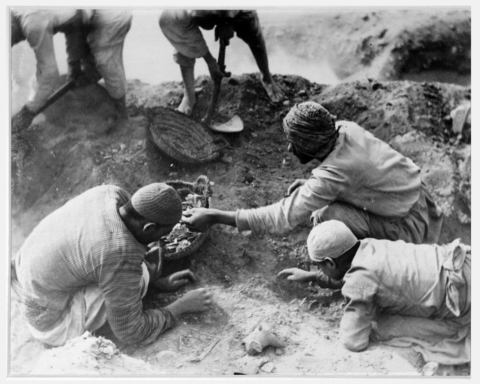
During lulls in papal business in the early 15th century, Poggio rode out across Europe, over the hills and through the forests of what is now France, Germany, and Switzerland, haunting monastic collections that had been neglected for generations.
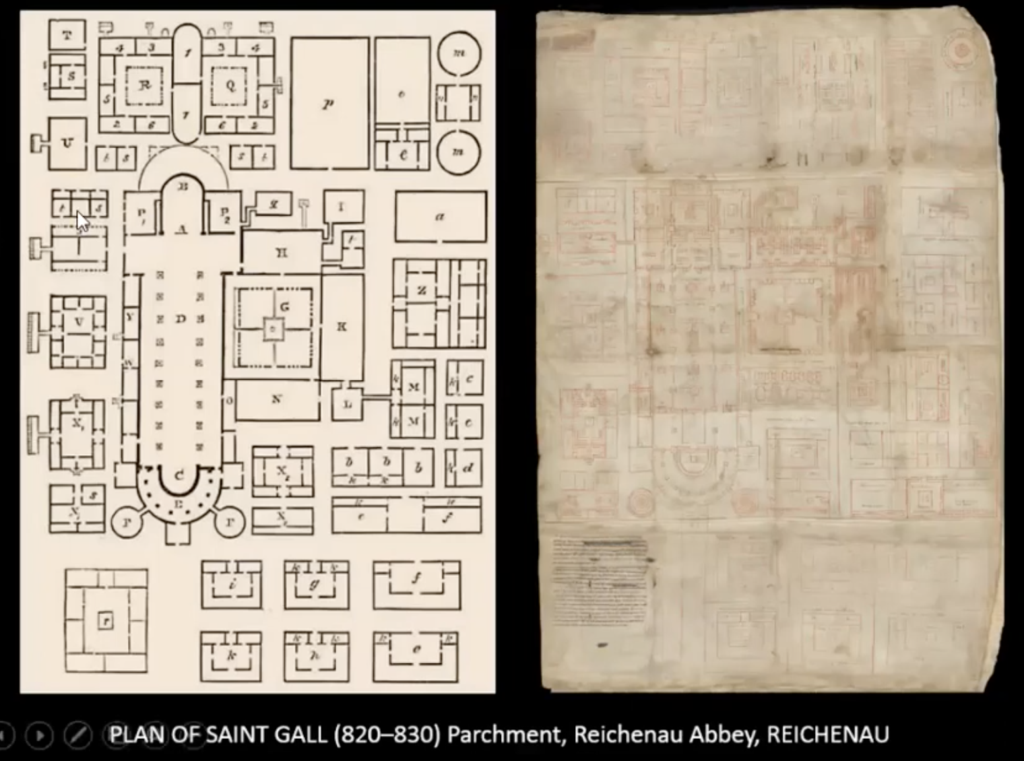
In 1415, at the abbey of Cluny, he uncovered two previously unknown speeches by Cicero. The following year, in the company of two young scribes, he found himself at the Abbey of St Gall, a Caroligian-era Benedictine monastery founded in 719 AD on the site of a shrine housing relics from one of Columbanus’ twelve companions. Upon his arrival he was appalled to find six of Cicero’s Orations in a heap of waste paper destined for the rubbish. As he and his companions explored the monastery library they would discover three books and part of a fourth of Valerius Flaccus’s Argonautica, the commentary of Asconius Pedianus on Cicero’s orations, as well as Vitruvious’s Ten Books on Architecture. These works, however important, were at this point already known. It wasn’t until they made their way to the recesses of the dank, neglected church tower, at the time being used to store overflow from the library, that they made their monumental discovery. Surviving on borrowed time among the dust covered insect infested volumes was a complete manuscript of Quintilian’s Institutio oratoria, a cornerstone of Roman rhetorical theory and up to that point only known in fragments.
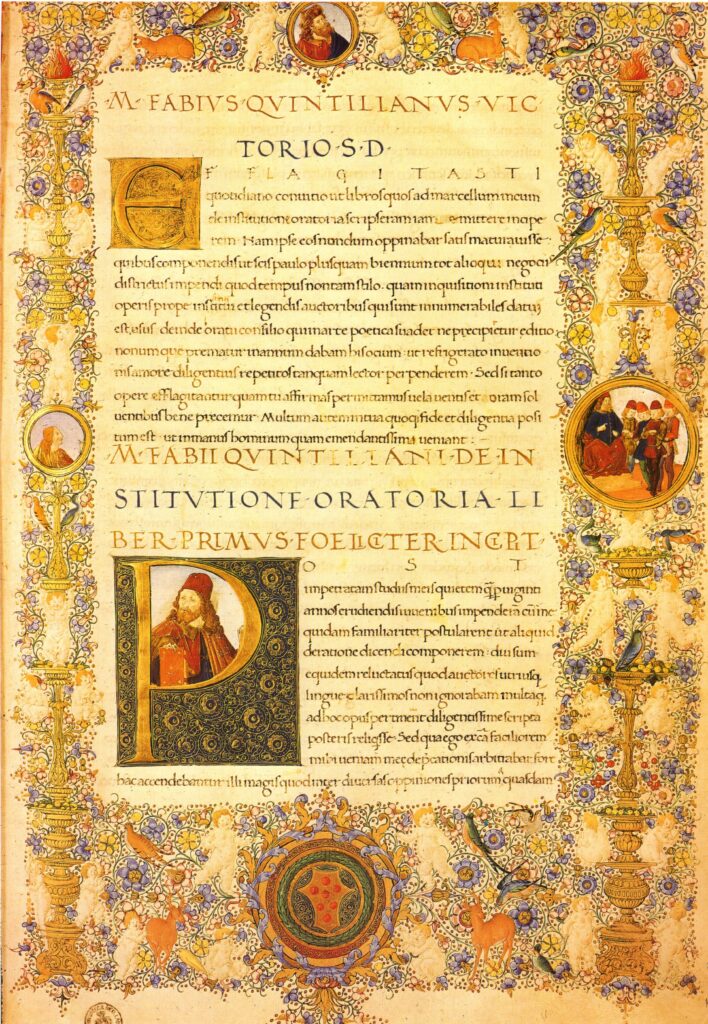
If ever another discovery could rival the monumental rescue and resuscitation of the Quintilian, it would come the following year in 1417. On a round of visits to monasteries like the 8th century Fulda and others in the German lands—Poggio unearthed a cascade of forgotten texts: Festus’s dictionary De significatu verborum; Lucretius’s philosophical poem De rerum natura; Manilius’s Astronomica; Silius Italicus’s epic Punica; large portions of Ammianus Marcellinus’s Res gestae; a Roman cookbook attributed to Apicius; and additional works by Cicero, including orations recovered at Langres and Cologne. He also recovered a copy of Statius’s Silvae, though the exact time and place of that find remain uncertain.
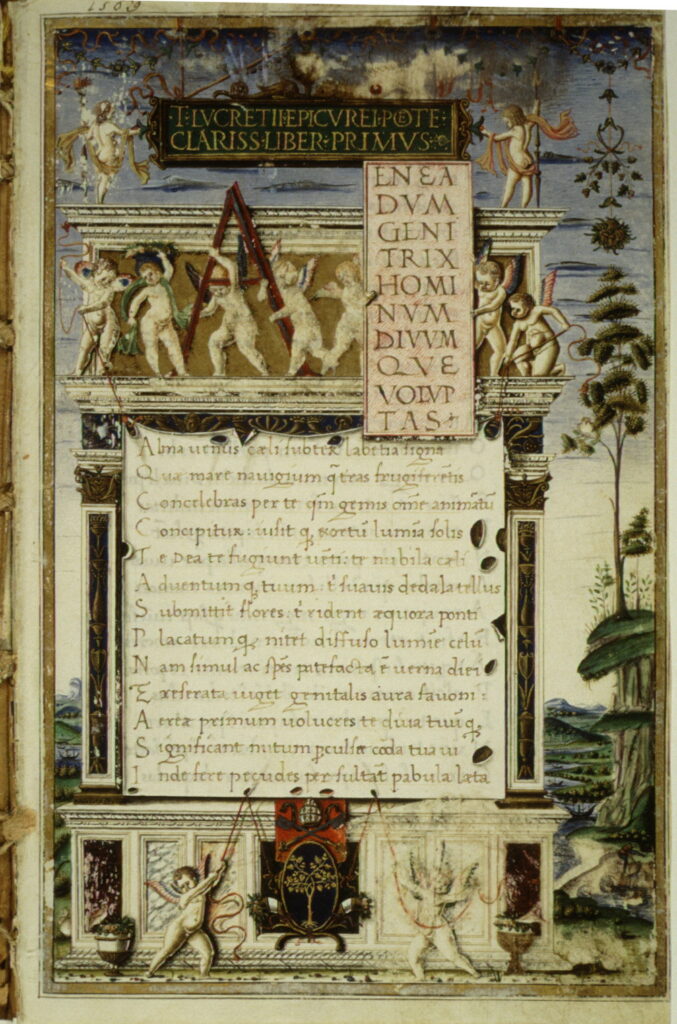
Not every expedition was a triumph. Poggio spent four years in England (1418–23), hoping to repeat his previous successes, only to find the island’s libraries poorly stocked by comparison. He eventually returned to Rome, resumed his duties as curial secretary, and kept hunting. In 1429, at Monte Cassino, he located Frontinus’s treatise on the aqueducts of Rome and the astrological work Matheseos libri by Firmicus Maternus, adding technical and scientific texts to his growing list of recovered authors.
Poggio’s achievements inspired his friend, Vespasiano Da Basticci, a Florentine bookseller and scribe who profiled his life and exploits alongside other notable contemporaries in his memoirs, as well as later writers like Ross King and Stephen Greenblatt. Stephen Greenblatt’s Pulitzer-winning book The Swerve: How the World Became Modern highlights Poggio’s recovery of De rerum natura as a pivotal moment in the transition to modern secular thought.
Poggio’s work exemplified the Renaissance pursuit of humanitas—a deep engagement with the cultural achievements of the past. By reviving the wisdom of the ancients and reintroducing it into Western learning, he helped bridge medieval scholarship and modern intellectual life. His discoveries not only enriched the literary heritage of Europe but also stimulated new thinking in philosophy, science, literature, and the arts.
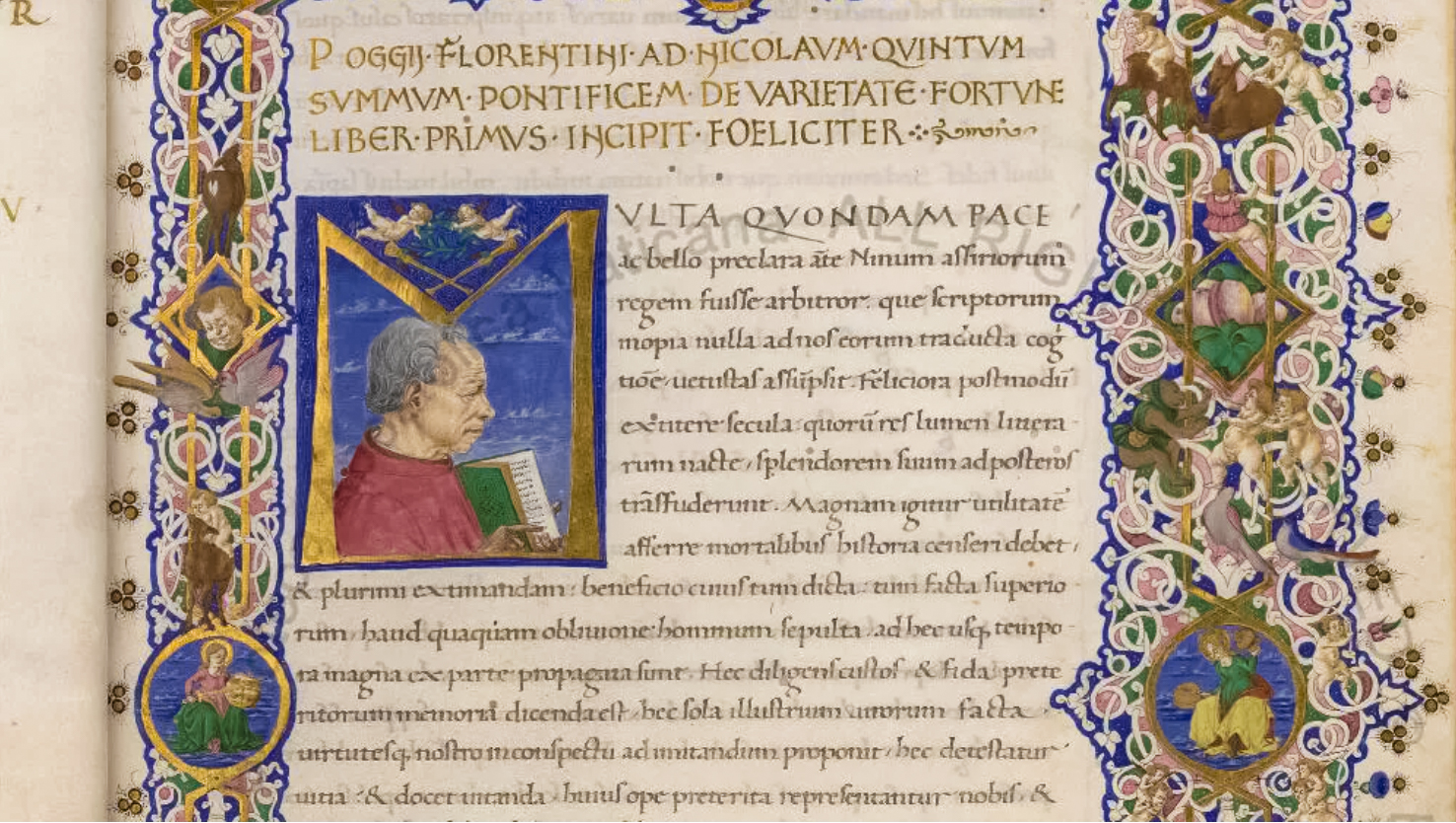
Poggio copied many of the manuscripts himself in his distinctive hand, producing clean, readable exemplars that could be further copied and circulated. Several of his autograph copies survive, tangible proof of how one man’s pen helped re-launch authors whose voices had nearly gone silent for a thousand years.
Poggio’s interests were not limited to manuscripts. Like many humanists, he was fascinated by the physical remains of antiquity. He studied ancient buildings, collected inscriptions, and adorned the garden of his villa near Florence with classical sculpture. Late in life, in 1453 he succeeded the humanist Carlo Aretino as chancellor of Florence, spending his final years in public office and composed a history of the city he had long served and loved.
He was not only a discoverer of texts but an author in his own right. Poggio wrote a series of Latin moral dialogues that circulated widely among humanist readers. In works such as De avaritia (On Avarice), De varietate fortunae (On the Variability of Fortune), De nobilitate (On Nobility), and Historia tripartita disceptativa convivalis, he used hypothetical conversations to probe wealth, status, and the unpredictability of human affairs. A darker tone surfaces in De miseria humanae conditionis (On the Misery of the Human Condition), where reflection on human weakness delves into pessimism.
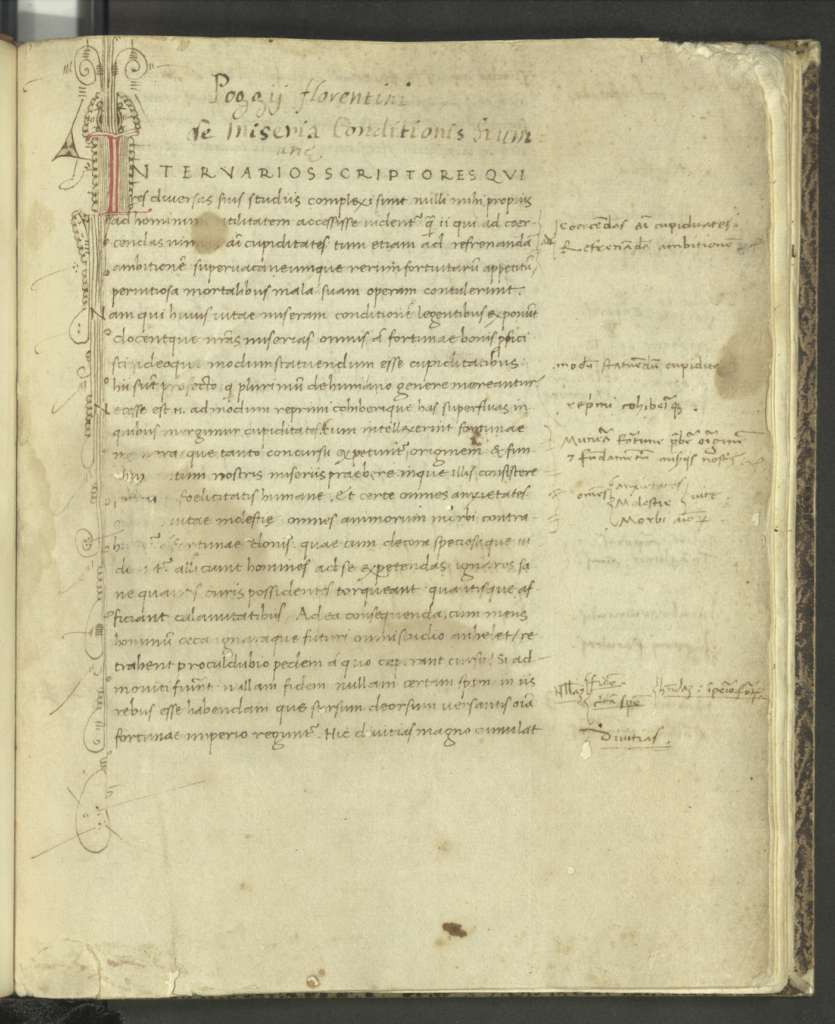
Yet Poggio also had a wicked sense of humor. His Facetiae—short, often bawdy anecdotes—circulated as a collection of sharp, irreverent tales, skewering monks, priests, and rival scholars with equal gusto. In polemical dialogues like Contra hypocritas (Against Hypocrites), and in his notorious invectives against fellow humanists, he deployed an astonishingly colourful Latin vocabulary to mock and attack opponents. Reading these texts, one sees not a dry antiquarian but a man very much alive to the vanities and absurdities of his own age.
When Poggio died in Florence on October 30, 1459, he left behind more than a list of recovered titles. He had helped reshape how Latin was written and read, supplied the Renaissance with crucial classical sources, and contributed his own sharp, often unsettling voice to the literature of his time. Thanks to the manuscripts he rescued and the pages he penned, we can still watch the ancient world re-enter European culture, book by book, line by line, through the eyes and hands of one tireless Florentine humanist.
Want to dig deeper? Check out;
The Vespasiano Memoirs – Vespasiano Da Basticci
The Bookseller of Florence – Ross King
The Swerve – Stephen Greenblatt
The Manuscripts Club – Christopher De Hamel