

The story of Khara-Khoto — a lost Tangut capital, buried by sand for five centuries, and the Russian expedition that pulled an entire vanished script back into the light.
Some cities, like Homer’s Troy, fall to conquest and are rebuilt on top of themselves, layer over layer, until nothing of the original is visible. Khara-Khoto did something rarer. It fell once, was abandoned outright, and the desert simply closed over it — sealing an entire civilization’s worth of books, paintings, and daily life under sand for more than five hundred years, undisturbed, until a Russian explorer with a gramophone and a dinner invitation talked his way inside.
A City Built at the Edge of the Silk Road
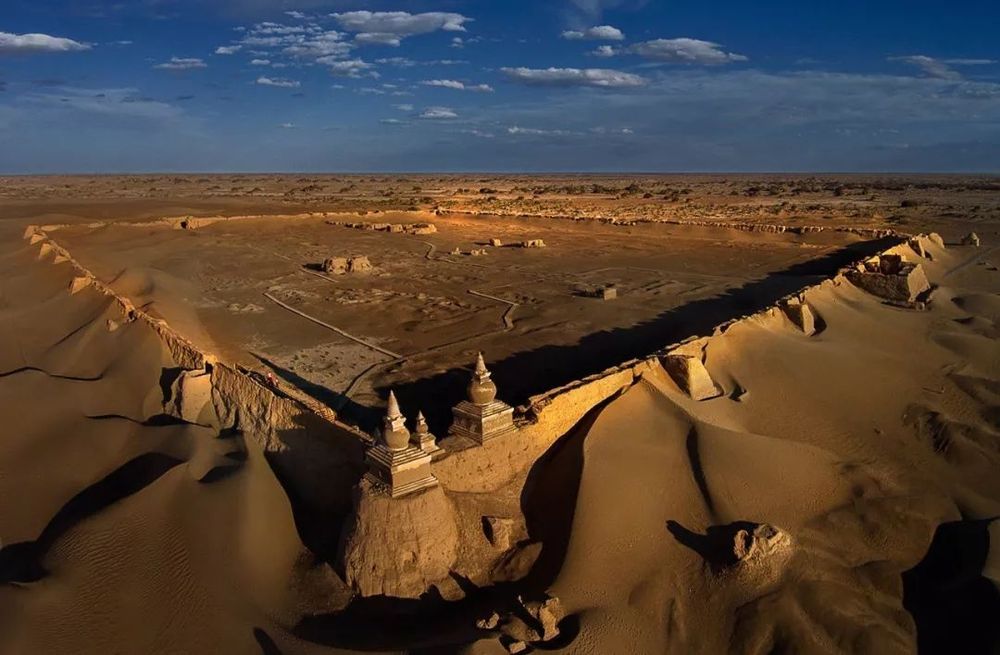
Khara-Khoto — Mongolian for “Black City” — sits in what is now Inner Mongolia, on the edge of the Gobi Desert along the Ejin River. It was founded in the 11th century under the Western Xia dynasty, a state built by the Tangut people, a group whose empire has largely been erased from popular memory despite ruling a large swath of northwestern China for roughly two centuries.
The Tanguts were not unimportant in their day. Their empire controlled a critical stretch of the Hexi Corridor, the trade artery where the Silk Road split into its northern and southern branches. Khara-Khoto grew into a genuine hub along that route — part garrison town, part trading post, part Buddhist pilgrimage center. Marco Polo is thought to have passed through the region in the late 13th century and referred to it as “Etzina,” describing a fortified town on the edge of the desert where travelers stocked up on provisions before a long, difficult crossing.
Buddhism flourished here. The Tanguts developed their own writing system — a famously intricate script visually related to Chinese characters but encoding an entirely different, unrelated language — and used it to translate and print an enormous body of Buddhist scripture, dictionaries, legal codes, and everyday documents. For a few centuries, Khara-Khoto was a real place where real people lived, worshipped, and kept records in a language built specifically for them.
The Siege and the Silence
The Tangut empire did not survive the Mongol conquests of the early 13th century — Genghis Khan’s campaigns effectively ended Western Xia as an independent state. Khara-Khoto itself limped on afterward under Mongol and later Yuan administration, but its final ending came in 1372, during a Ming dynasty campaign to root out the remnants of Mongol power in the region. The city was besieged and, according to most accounts, its water supply was cut or diverted, forcing its final collapse.
After that, Khara-Khoto was simply left. Whatever combination of military destruction, water shortage, and advancing desertification made the site untenable, no one came back to resettle it. The sands did the rest, gradually burying streets, temples, and the possessions of everyone who had once lived there. A local legend attached itself to the ruins — a story of a doomed general who, facing defeat, buried the city’s treasure in a well before dying in a final, hopeless stand rather than surrendering it. Whether or not that specific tale is true, it captures something real about the site: everything of value inside those walls stayed inside those walls, deliberately or otherwise, for over five hundred years.
By the time Western explorers began surveying Central Asia in the late 19th century, Khara-Khoto was little more than rumor — a name mentioned by local nomads, a half-remembered “black city” downstream along the Ejin River, unconfirmed on any map that mattered.
Kozlov Finds the City
Credit for turning rumor into rediscovery belongs to Pyotr Kuzmich Kozlov, a Russian explorer and naturalist who had spent years working in Central Asia under the wing of the legendary geographer Nikolai Przhevalsky. Earlier travelers, including Grigory Potanin and Vladimir Obruchev, had already heard whispers of the lost city and passed word back to Russia, where it caught the attention of the Russian Geographical Society and the Asiatic Museum in St. Petersburg.
Kozlov set out in 1907 on what was officially billed as a Mongolia-Sichuan expedition. By 1908, he had located the ruins. In a small, almost comic footnote to a genuinely major discovery, Kozlov secured permission to excavate the site from Dashi Beile, a local Torghut Mongol chief, in exchange for a dinner and the gift of a gramophone.
What Kozlov found once he was inside the walls exceeded almost anyone’s expectations.
What the Desert Had Kept
The Gobi’s extreme aridity had acted as an accidental preservation chamber. Paper, silk, and wood that would have rotted away in almost any wetter climate had simply sat, undisturbed, in the dry air for over five centuries.
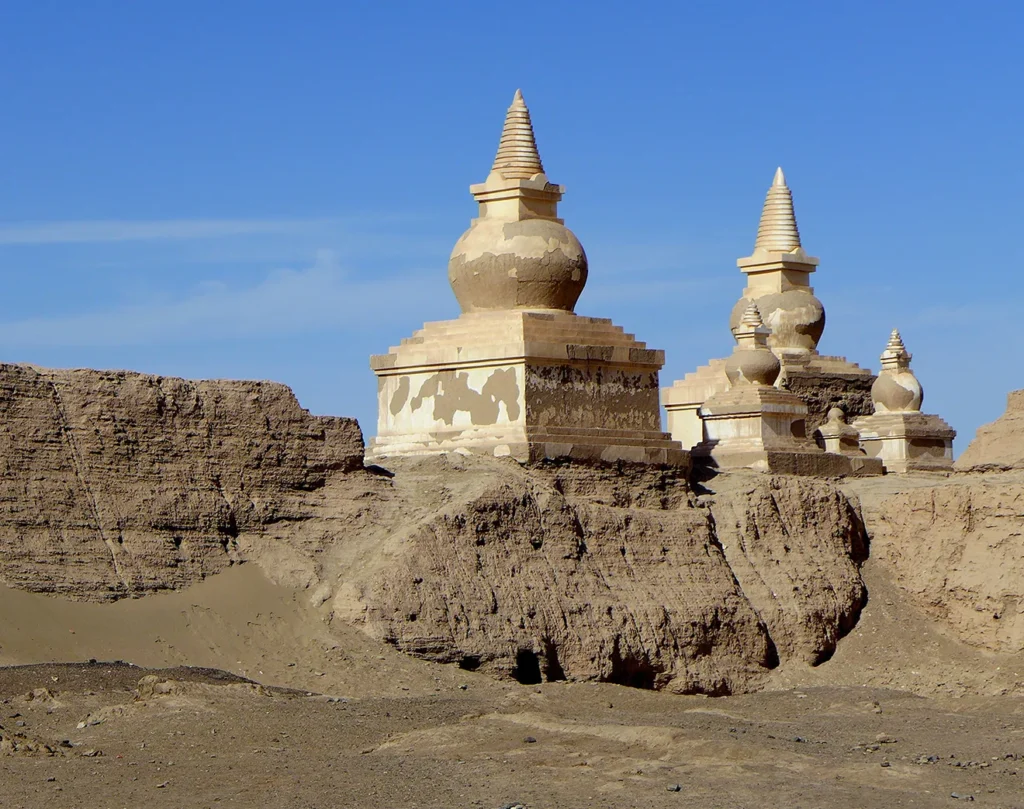
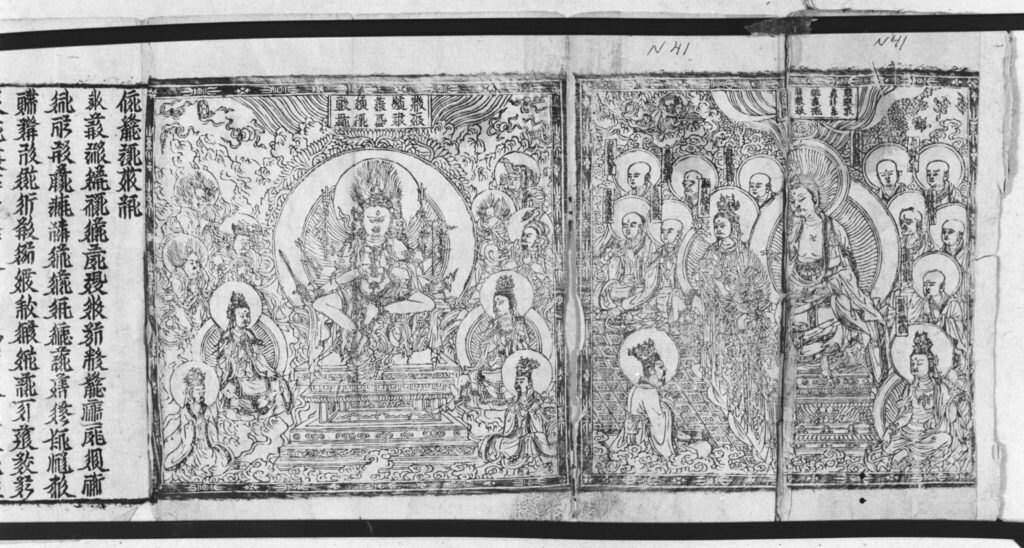
Kozlov’s most extraordinary find came from a large stupa (a Buddhist commemorative structure) standing outside the city walls. Inside it, he uncovered a hoard of roughly two thousand books, scrolls, and manuscript fragments, along with Buddhist paintings, printed woodblock texts, statues, and devotional objects. A second expedition the following year, in 1909, turned up still more material, including additional Buddhist statuary and further caches of manuscripts.
The bulk of the written material was in the Tangut script — the same intricate, invented writing system the Western Xia state had used for centuries, and which had gone effectively extinct and unreadable after the Tangut language itself died out sometime in the Ming dynasty. Alongside it were significant quantities of material in Chinese and Tibetan, reflecting the multilingual, cosmopolitan nature of the Tangut Buddhist world.
Everything Kozlov collected was shipped back to St. Petersburg, where it entered the Asiatic Museum’s collections — the core of what is now held by the Institute of Oriental Manuscripts of the Russian Academy of Sciences, with associated artwork housed at the State Hermitage Museum. It remains there today, forming one of the largest single archives of Tangut material anywhere in the world.
Reading a Language No One Could Read
The Tangut language had been dead for centuries by 1908, and its script — visually dense, superficially resembling Chinese but structurally unrelated — was completely undeciphered.
The breakthrough came from within the hoard itself. Among the thousands of items were crucial bilingual and multilingual materials — dictionaries and glossaries that Tangut scholars had themselves compiled centuries earlier, pairing Tangut characters with their Chinese equivalents. One of the most valuable of these was a work known as Pearl in the Palm, a Tangut-Chinese glossary that gave 20th-century scholars exactly the kind of parallel-text foothold that the Rosetta Stone had once given Egyptologists.
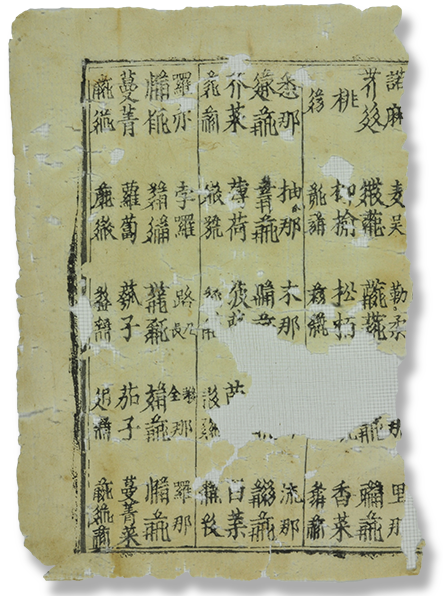
Russian scholars, particularly Aleksei Ivanov, began working through this material in the years immediately following Kozlov’s return, gradually building the first real dictionaries and grammars of the Tangut language based on the Khara-Khoto finds. It was slow, painstaking work, but it succeeded: an entire written language, unread since the Middle Ages, was pulled back into legibility largely because the people who once used it had, without knowing it, left their own answer key sitting in a stupa in the desert.
The Prints, the Paintings, and What Came After
Beyond the linguistic breakthrough, the material haul itself was extraordinary. The Khara-Khoto collection included large numbers of woodblock-printed Buddhist texts and finely detailed thangka-style paintings, offering an unusually rich visual record of Tangut Buddhist art — a tradition that drew on Chinese, Tibetan, and Central Asian influences simultaneously, and that had been almost entirely invisible to art historians before these finds. Printing itself is part of the story here too: the broader Tangut world, of which Khara-Khoto was a part, produced some of the earliest surviving examples of printed books anywhere on earth, underscoring how sophisticated and literate this “forgotten” civilization actually was.
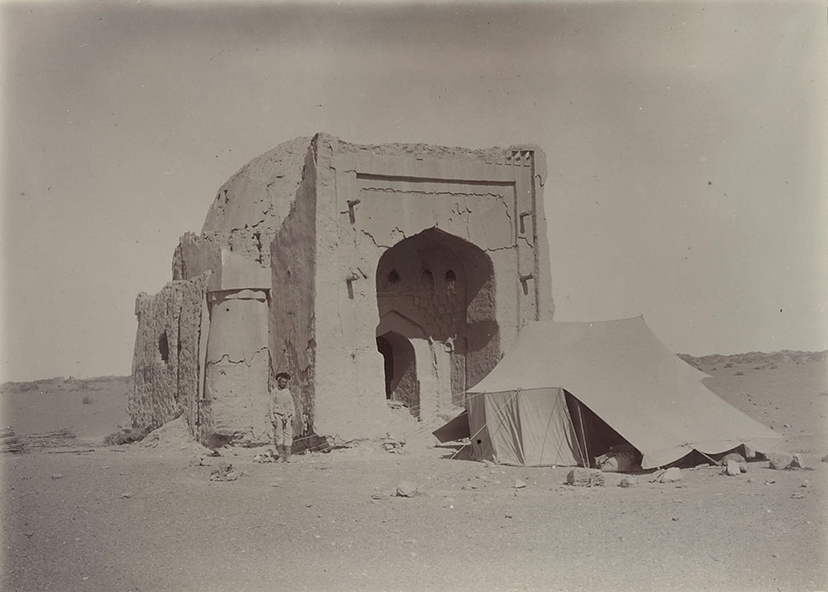
Kozlov was not the last outsider to visit the ruins. The renowned Hungarian-British archaeologist Aurel Stein reached Khara-Khoto during his third and most ambitious Central Asian expedition, an extraordinary undertaking that covered nearly 11,000 miles over thirty-two months between 1913 and 1916. Stein’s route alone reads like an atlas of Silk Road archaeology: he followed the old pilgrim road from Kashmir to Kashgar, crossed the Taklamakan Desert to Khotan, pushed into the Lop Desert to uncover the ancient site of Lou-lan, and returned to the Mogao “Caves of the Thousand Buddhas” at Dunhuang, where he had already made his name a few years earlier. From there he followed the Etsin-gol downstream and arrived at Khara-Khoto itself, spending roughly a week combing through what Kozlov had left behind and recovering further manuscript fragments, which today form a smaller but still significant collection held in London. He then pressed on to Turfan, where his expedition secured an important collection of mural paintings from ruined Buddhist shrines, before eventually shipping some 182 cases of antiquities back toward Kashmir. Chinese archaeological work at Khara-Khoto and related Tangut sites has continued in the decades since, adding further material — including, at other Tangut sites in the region, discoveries such as an entire cache of Buddhist scripture uncovered in pottery jars, which now forms part of the core Tangut holdings of the National Library of China.
The Book This Story Left Behind
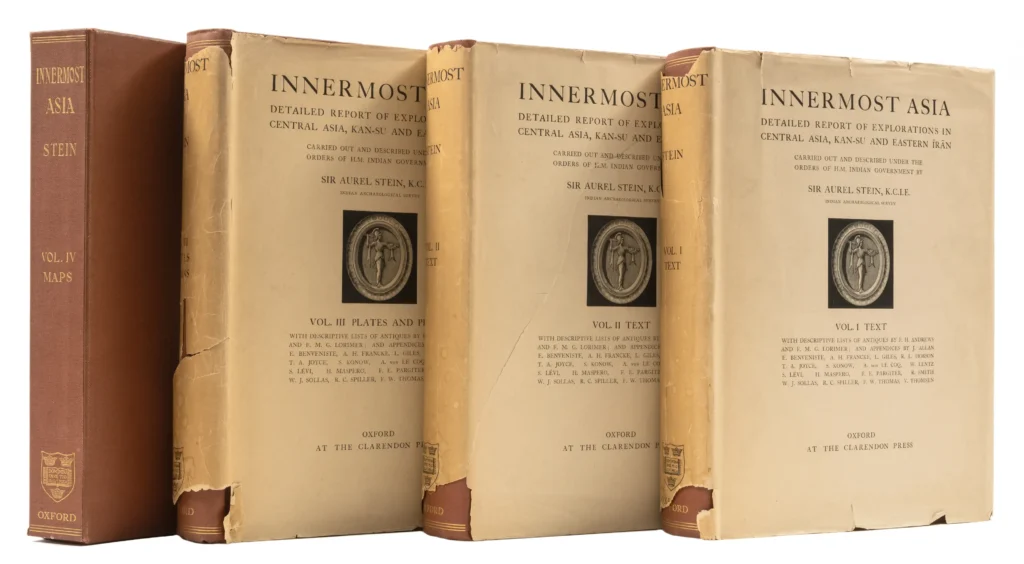
Stein was as methodical a writer as he was a traveler, and his account of the 1913–1916 expedition, Innermost Asia: Detailed Report of Explorations in Central Asia, Kan-su and Eastern Iran, remains the definitive scientific record of the Khara-Khoto expedition and everything that surrounded it. Published by Oxford in 1928 in four hefty quarto volumes, it’s less a travel narrative than a complete scholarly excavation report — 138 plates (thirteen in color), 59 site plans, over 500 photographic illustrations, and a separate box containing 52 folding color maps charting the full sweep of Stein’s route across the Taklamakan, the Lop Desert, and down the Etsin-gol to Khara-Khoto itself.
It’s exactly the kind of book that makes a story like this feel tangible rather than remote — a physical object you can put on a shelf that connects directly back to the sand, the stupa, and the manuscripts. A first edition set recently came up at Forum Auctions in London, estimated at £5,000–£7,000 and hammering at £12,500 — a reminder of just how sought-after Stein’s original reports remain among collectors of exploration and Central Asian material. This particular set carried extra provenance worth noting: it belonged to Filippo de Filippi, the Italian doctor, mountaineer, and explorer who led his own major scientific expedition through the Himalaya, Karakoram, and Eastern Turkestan in 1913–1914, and who was a close personal friend of Stein’s. De Filippi’s small book-label is still mounted to the front pastedowns of each volume — one explorer’s library copy of another explorer’s magnum opus, both men working the same forbidding stretch of Central Asia within a few years of each other.
A City Rediscovered, A Civilization Restored
What makes Khara-Khoto remarkable isn’t simply that a lost city was found — deserts have given up plenty of ruins. It’s that the discovery came essentially complete: not just walls and foundations, but a functioning cross-section of an entire vanished civilization’s intellectual and religious life, sealed and waiting. A dead language, an unread script, a forgotten Buddhist artistic tradition, and a genuinely major regional power that had all but disappeared from the historical record — all of it was sitting in the sand along the Ejin River, waiting on a dinner invitation and a gramophone.
Today, Khara-Khoto’s towers still stand, worn down but recognizable, twelve meters high in places, rising out of the Gobi. The books that once filled its stupa now sit in climate-controlled archives in St. Petersburg and London, a very long way from where they were written. But because of what Kozlov carried out of that desert, the Tangut world isn’t silent anymore. It’s simply waiting to be read.
Know of a lost city, forgotten script, or buried archive you think belongs on The First Folio? Get in touch — this is exactly the kind of story we’re here for.