

Cardinal Angelo Mai’s discovery of Cicero’s De Re Publica hidden in a palimpsest that was buried in the stacks of the Vatican archives using what was, at the time, cutting edge forensic analysis is an incredible tale of one mans devotion to rescuing foundational texts from the brink of oblivion, and one of the most famous finds in the history of classical scholarship.
The Loss of De Re Publica
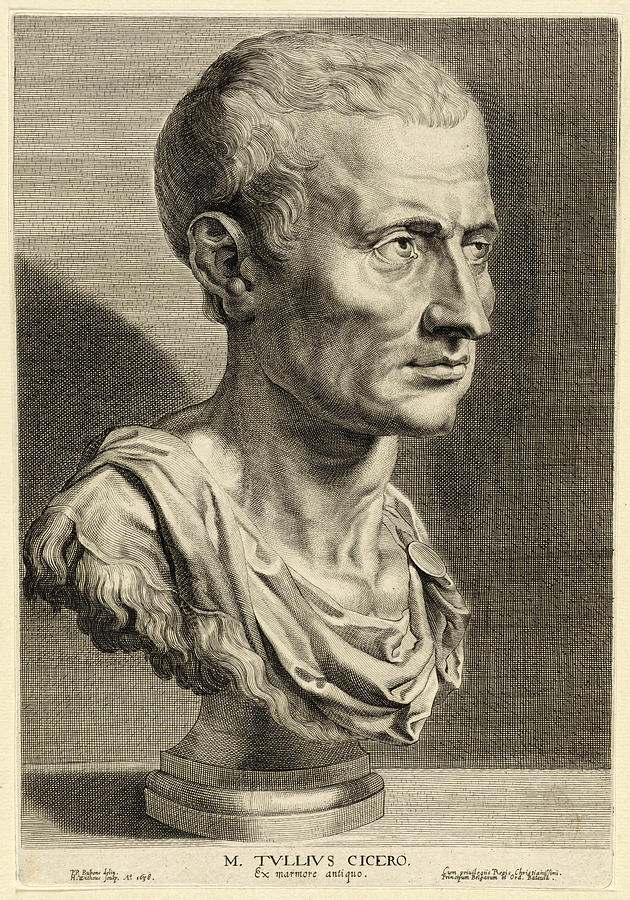
Marcus Tulius Cicero (3 January 106BC – 7 Dec 43 BC), was a Roman statesman, lawyer, writer and philosopher who played a central role in the events surrounding the rise and fall of Julius Caesar, the collapse of the Roman Republic, and the subsequent rise of the Roman Empire. He composed De Re Publica between 54 and 51 BC, during a period of reprieve from active politics under the strains of the First Triumvirate.
Structured as a dialogue set in 129 BC and featuring Scipio Aemilianus and his circle, the work, modeled loosely on Plato’s Republic, examined the ideal form of government, drawing heavily on Cicero’s admiration for the mixed Roman constitution (a blend of monarchic, aristocratic, and democratic elements) as superior to Plato’s purely theoretical ideal state.
The work was influential in antiquity — Church Fathers like Augustine and Lactantius quoted from it — but it did not survive the transition from scroll to codex particularly well, and by the early Middle Ages it seems to have largely faded into ever-fewer copies. By the Carolingian period, direct knowledge of the text had essentially vanished in the West, surviving only through quotations and paraphrases in later authors (Augustine’s City of God, Lactantius, Macrobius, Nonius Marcellus), and The “Somnium Scipionis”, or (“Dream of Scipio”), the closing section of Book VI, which survived independently because Macrobius wrote an extensive commentary on it that remained popular throughout the Middle Ages. So for roughly a thousand years, scholars knew De Re Publica existed and had a rough sense of its themes, but the actual text was believed permanently lost.
Palimpsests and the Practice of Erasure
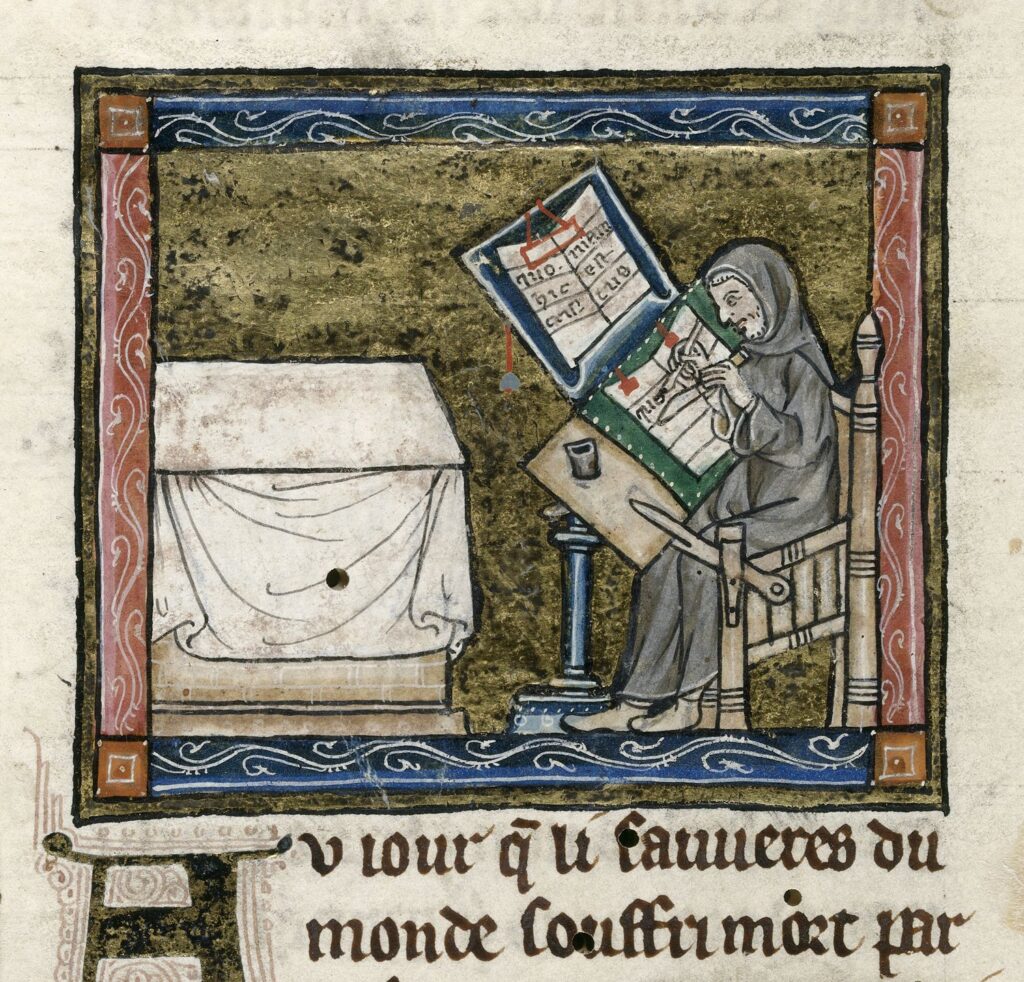
To understand Mai’s discovery, we must examine the physical culture of medieval manuscript reuse. Parchment (prepared animal skin) was expensive and labor-intensive to produce. When monasteries needed writing material and didn’t have blank parchment, monks would sometimes take older manuscripts — especially ones considered obsolete, pagan, or simply less valuable — and scrape or wash off the original ink with a knife or pumice stone and mild acid, then write new text over the top.
This reused manuscript is called a palimpsest (from Greek palimpsestos, “scraped again”). However, the erasure was rarely perfect. Ink often penetrated the parchment fibers below the surface, meaning ghostly traces of the original text remained, sometimes visible under raking light, and later, when chemically enhanced.
In this specific case, the manuscript had originally contained Cicero’s text (probably copied in the 4th or 5th century), and in the 7th century a monastery — possibly at Bobbio, an Irish foundation in northern Italy famous for its library and its habit of recycling older classical manuscripts — had scraped it down and copied over it a text of St. Augustine’s Enarrationes in Psalmos (Commentary on the Psalms).
Angelo Mai: The Man
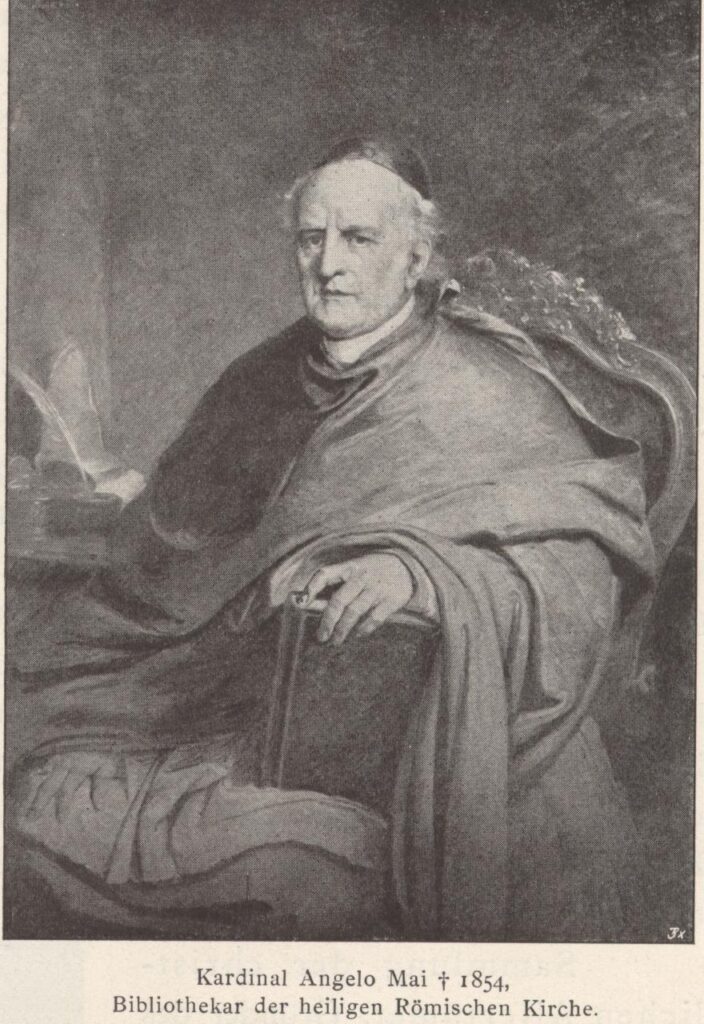
Angelo Mai (1782–1854) was born in Bergamo and trained in the Jesuit school of Catholocism. He developed extraordinary skill in paleography and became librarian first at the Ambrosian Library in Milan, then, from 1819, at the Vatican Library, eventually rising to be a cardinal in 1838.
Mai had already made his name before the de re publica discovery. At the Ambrosian, he had uncovered fragments of Cicero’s speeches, portions of Plautus, and other classical texts hidden in palimpsests — establishing his reputation as Europe’s foremost “manuscript detective.” His move to the Vatican Library gave him access to an even richer, largely unexplored collection.
The Discovery
In 1819, while working in the Vatican archives, Mai noticed that beneath the visible text of Augustine’s Psalm commentary, there were traces of an earlier hand. Using techniques that had become somewhat established in palaeographic circles — applying chemical reagents, notably tincture of gallnuts (gallic acid) or occasionally Prussian blue reagents, which react with iron in old ink to darken faded traces — Mai was able to bring the underlying script back into legibility.
Working through the manuscript leaf by leaf, he gradually recognized the content as Cicero’s lost De Re Publica. He announced and published his findings in 1822 as M. Tulli Ciceronis De Re Publica quae supersunt — essentially “What Survives of Cicero’s On the Republic.”
The discovery caused a genuine sensation in European intellectual circles. This was the era of Romantic classicism, when the recovery of ancient texts carried enormous cultural weight. Scholars across Europe, including in Germany (a center of classical philology at the time under figures like Niebuhr), celebrated the find. Mai became something of a celebrity scholar, and the Vatican’s prestige as a center of learning was burnished considerably.
Napoleon’s former tutor and various European intellectuals corresponded about the find, as it fed into broader 19th-century enthusiasm for recovering the classical past, paralleling contemporary excitement about Herculaneum papyri and Egyptian decipherment efforts.
The Cost
The techniques Mai used, while groundbreaking, were also destructive. Chemical reagents that temporarily revive faded ink often cause long-term damage — darkening and degrading the parchment further, sometimes obscuring text permanently after an initial period of legibility. This was a widespread problem in 19th-century palimpsest work generally, and Mai’s Cicero manuscript suffered from it. Modern scholars examining the manuscript have had to contend with chemical staining that Mai’s own methods introduced.
As a result, what survives of De Re Publica today is fragmentary — roughly a quarter to a third of the original six books, concentrated in Books I and II, with the rest known only through the pre-existing indirect tradition (quotations, and the separately-preserved “Dream of Scipio”). We have Cicero’s own framing of the work’s central question — what constitutes the best constitution — but not the complete text he wrote.
Mai’s Broader Legacy
Mai went on to recover portions of other lost or fragmentary classical works using similar palimpsest techniques, including fragments of Fronto’s letters and various legal and grammatical texts. He became the era’s leading figure in this particular niche of textual archaeology, and his edition of De Re Publica remained the foundational text for subsequent scholarly editions throughout the 19th century.
Modern techniques — multispectral imaging, UV fluorescence, and digital enhancement — have since allowed scholars to reread portions of the Cicero palimpsest without further chemical damage, refining Mai’s original transcriptions in some places. But the basic textual recovery, and the story’s status as a landmark moment in the history of classical philology, remains tied to Mai’s 1819–1822 work in the Vatican Library.